
Ontario County Court Records After Arrest
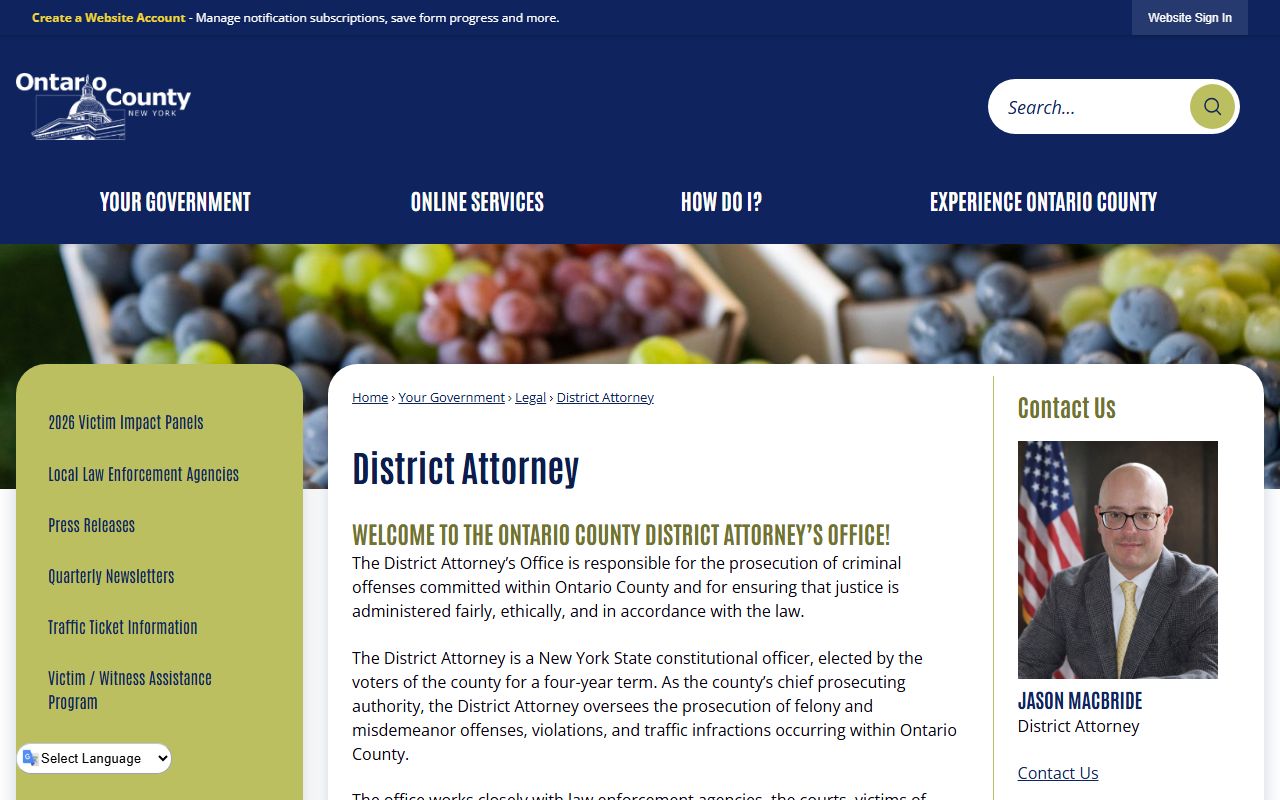
Ontario County court records after a jail arrest are not the same thing as the first jail entry. The booking side is handled through Ontario County Jail and the Ontario County Office of Sheriff under Sheriff David Cirencione. The court side begins when the case reaches a local criminal court, Ontario County Court, or another court with authority over the charge. For felony and misdemeanor offenses, violations, and traffic infractions committed in Ontario County, the Ontario County District Attorney is the county's chief prosecuting authority. District Attorney Jason MacBride's office reviews police papers, works with law enforcement, and decides how the charge should move in court.
That distinction matters because a jail record may show custody, bond, court information, and projected release, while the court record shows the accusatory paper, docket activity, charge status, plea, conviction, dismissal, or other disposition. For current custody and booking context, the jail roster path is handled separately through Ontario County jail inmate records. Booking photos and public photo limits are treated separately on the Ontario County jail mugshots page. The court record is the better source for what the prosecutor filed and what the judge later did with the case.
Find Ontario County Court Records After Arrest
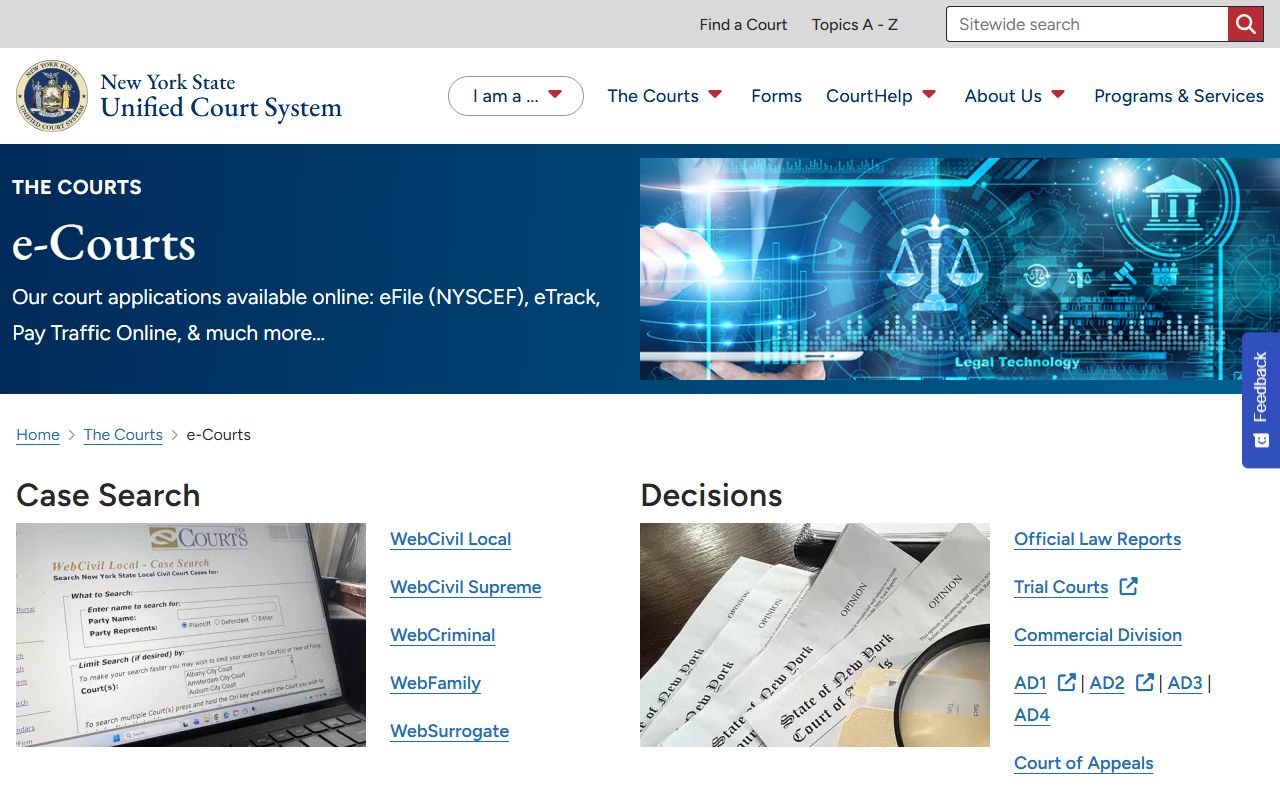
The statewide court starting point is the New York Unified Court System's e-Courts portal, which links to WebCriminal and other court applications. WebCriminal is the public case-search route for many pending criminal matters. Older files, certified copies, and records that do not appear clearly online may require a request to the Clerk of the Court or the Ontario County Clerk. The county budget identifies the Ontario County Clerk as the custodian of official civil and criminal records of Supreme Court and County Court filed in that office. The County Clerk is at the County Municipal Building, 20 Ontario Street, Canandaigua, NY 14424, and the researched phone number is 585-396-4200.
The New York Courts records guidance says court records and case information can be requested from the court clerk or County Clerk that has the file. FOIL is useful for agency records, but court case files are not usually requested from the sheriff or county FOIL office as if they were jail records. If a person was just arrested and the court case is not yet easy to find, the Ontario County Jail automated line may still provide charges, bond, court information, and projected release details.
- Start with New York e-Courts and choose the criminal case-search route, such as WebCriminal, when available for the case type.
- Search by the defendant's full name, date cues, or case number if one is known. Name spelling can matter.
- Open the case entry and read the charge list, court, next appearance, and status fields before drawing conclusions.
- For certified copies, older files, or unclear entries, contact the court clerk or Ontario County Clerk rather than the jail.
The state also offers the OCA Criminal History Record Search, often called CHRS. CHRS is a statewide exact-match name and date-of-birth search. It costs $95, can be submitted online or by mail, and reports public open, pending, and conviction records from criminal cases that originate in County, Supreme, City, Town, and Village courts across all 62 New York counties. It is not a nationwide search, not an FBI search, and does not disclose sealed records.
The e-Courts page shown in the official screenshot links the public to WebCriminal and related case systems.
View the New York e-Courts source page.
Use that court route for filed charges, while using Ontario County Jail only for the custody and booking side of the same arrest.
Ontario County Court Search Fields
Court records after an Ontario County arrest can be searched in more than one place, so the fields are not identical. WebCriminal is a case-search path, while CHRS is a paid statewide criminal-history search. CHRS is exact match, which means a name variation, alias, or wrong birth date can miss a record. Each alias and each date of birth is treated as a separate search by OCA.
| Field | Channel | Required | Notes |
|---|---|---|---|
| Full name | CHRS / court search | Yes for CHRS | CHRS reports exact name and date-of-birth matches only. |
| Date of birth | CHRS | Yes | Each separate DOB is an additional search. |
| Case number | e-Courts / clerk | No | The fastest route when a docket or case number is already known. |
| Submitter contact | CHRS | Yes | OCA requires requester name, address, and phone on the application. |
| Payment | CHRS | Yes | The researched fee is $95; mail requests use check or money order, not cash. |
| Email address | CHRS | Optional | Needed if the requester wants eligible results returned by email. |
Ontario County Arrest Charging Papers
After arrest and booking, the first court record usually turns on an accusatory instrument. That paper tells the court what offense is being alleged and why the case should proceed. In Ontario County, the District Attorney may continue, amend, reduce, dismiss, or replace charges as the case moves. Felony cases can move from a local court stage toward Ontario County Court if indictment or superior court filing occurs.
| Document | Who Uses It | Common Role | What to Check |
|---|---|---|---|
| Complaint | Police or prosecutor | Initial accusatory instrument in local criminal court | Original charge, incident summary, filing court |
| Information | Prosecutor | Legally sufficient paper often used for misdemeanors | Final misdemeanor charge language and supporting facts |
| Indictment | Grand jury | Formal felony accusation in superior court | Count numbers, felony class, replaced or added charges |
| Superior Court Information | Prosecutor and defendant after waiver | Felony charging document when indictment is waived | Waiver, plea posture, filed counts |
Ontario County Charge Status Records
Charge status can change after an arrest. A booking charge may be broad or preliminary. The prosecutor may file a different offense, add counts, reduce a felony, dismiss a count, or replace local-court papers with an indictment. A court record should therefore be read by date and by count. One charge can be pending while another has been dismissed, and a later plea can be to a different count than the one first seen after booking.
| Status | Plain Meaning | Why It Matters |
|---|---|---|
| Pending | The charge is still open in court. | It is an accusation, not a conviction. |
| Amended | The charge wording, level, or count changed. | The filed court charge may differ from the jail booking entry. |
| Reduced | A more serious charge was lowered. | Plea offers and dispositions often use reduced charges. |
| Dismissed | The court ended that count without conviction. | Sealing may later apply if the action ended in favor of the accused. |
| Convicted | A guilty plea or verdict was entered. | The conviction record is different from the arrest or charge alone. |
Bail After Ontario County Arrest
Release after arrest is controlled by the court, not by the jail. New York Criminal Procedure Law section 510.10 sets the framework for recognizance, non-monetary conditions, bail, and remand. CPL section 530.20 covers securing orders in local criminal court. A securing order is the court order that says whether the defendant is released, released with terms, must post bail, or is held.
Ontario County Jail processes bail after the court has set it. The Corrections FAQ says bail may be paid online through GovPayNow or GovPayNet, by phone at 1-877-EZBAIL5, or in person at the jail lobby. The payer needs the inmate's criminal history number, bail amount, date of birth, court, judge information, and pay location code 1996. The jail line at 585-396-1800 is the official local source for those details. Card bail carries a non-refundable 9% GovPayNet fee, and the court later keeps 3% of returned bail after the case concludes.
| Release Term | Meaning |
|---|---|
| Recognizance | Release based on a promise to return to court. |
| Non-monetary conditions | Release with court terms that do not require money. |
| Cash or card bail | Money posted after the court sets bail; Ontario County accepts in-person and remote payment routes. |
| Remand | A court order holding the person without release. |
| Hold or detainer | Another warrant, agency interest, parole matter, or transfer issue that can block release. |
Warrants Before Ontario County Arrest
No official Ontario County public active-warrant search page was found in the inspected sources. That means a court record or jail booking should not be treated as a complete warrant list. If a warrant led to the arrest, the warrant may appear through court activity, the issuing court, or jail information after booking. A bench warrant is usually issued by a judge for failure to appear or a court-order violation. An arrest warrant authorizes an arrest in a criminal matter. A search warrant is different because it authorizes a search, not custody.
For warrant questions, use official channels. The researched Sheriff non-emergency numbers are 585-394-4560, 315-781-1200, and 1-800-394-4560. If the person is already held at Ontario County Jail, the jail line is 585-396-1800 or 315-781-1966. Open warrant records may be limited when disclosure would interfere with enforcement or safety. Walking into a law-enforcement office just to check an active warrant can result in arrest, so legal advice or contact with the issuing court may be prudent.
Charges Convictions Sealed Records
A charge is an accusation. A conviction is the result of a guilty plea or verdict. Court records after an Ontario County arrest should be read with that line in mind, because a search result can show open charges long before the case is resolved. CHRS may show public open, pending, and conviction records, but it does not report sealed records or several excluded categories.
| Issue | Charge | Conviction |
|---|---|---|
| Stage | Filed accusation after arrest or prosecutor review | Final result by plea or verdict |
| Proof | Not proof of guilt | Legal finding or admitted guilt |
| Can change | Can be amended, reduced, or dismissed | Can still be sealed or appealed in limited settings |
New York generally uses sealing more than broad expungement for ordinary criminal cases. Under Criminal Procedure Law section 160.50, when a criminal action terminates in favor of the accused and sealing applies, official arrest and prosecution records are sealed and photographs or fingerprints tied to the action are destroyed or returned unless an exception applies.
| Issue | Sealed | Expunged |
|---|---|---|
| Public access | Closed from ordinary public or private searchers | Destroyed or treated as removed where law allows |
| New York practice | Common term for eligible dismissed or restricted cases | Not the usual remedy for most adult New York criminal matters |
| Effect on CHRS | Sealed records are not disclosed | Not listed if no public record remains |
Restricted Ontario County Court Records
Some court records after arrest are not public. Sealed records, youthful-offender records, certain pending youthful-offender eligible matters, Family Court transfers, and records restricted by a specific statute may be withheld from public lookups. Criminal Procedure Law section 720.35 protects youthful-offender records, which is one reason youthful-offender information is not treated like an ordinary public criminal case. FOIL also has law-enforcement, safety, privacy, and active-proceeding limits.
Important: A public court lookup is not a consumer report and should not be used for credit, housing, insurance, employment, or other FCRA-covered screening.
The District Attorney page is useful for understanding prosecution responsibilities, not as a general case-search portal.
View the Ontario County District Attorney source page.
For filed court records, use e-Courts, WebCriminal, the court clerk, the County Clerk, or CHRS rather than relying on prosecution office contact alone.
Public Record Search
Sponsored Results